Rate-Cut Odds Sink to 1% on Polymarket as September Becomes a Coin Toss
CME’s FedWatch Tool is now implying a September rate hike is the likeliest outcome, but prediction markets remain almost evenly split—setting up a high-stakes, data-dependent finish to the month.
Futures tip toward a hike
According to CME’s FedWatch Tool (as cited in the source), traders now price a 25-basis-point increase at 57% for the Federal Reserve’s Sept. 16 federal funds rate decision. The source adds that staying at the current range holds 43% odds. By the source’s account of CME data, odds for a September hike were just 39.9% on Aug. 21 but rose to 57% by Aug. 28, following Jackson Hole remarks. The source also states that a hike would lift the target range to 3.75%–4.00% from 3.5%–3.75%.
Prediction markets keep it a coin toss
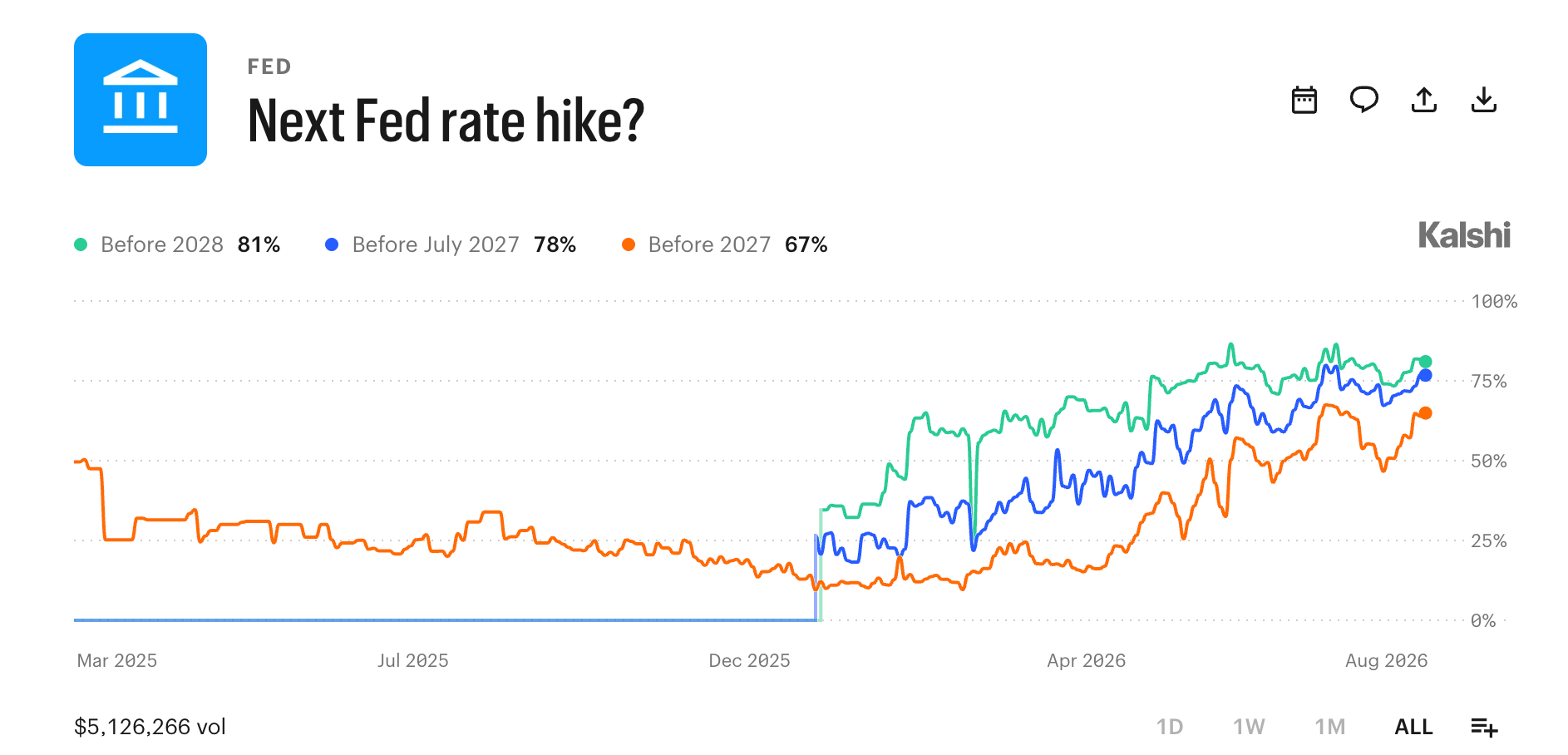
The source reports that Polymarket traders price a hold at 52% versus 48% for a 25-basis-point hike, with more than $66.6 million traded in that market. It also notes that a September rate cut contract sits near 1% odds. On Kalshi, the source describes nearly identical odds—52% for no change and 48% for a quarter-point increase—on a market with over $23.8 million in volume. A separate Kalshi contract, per the source, gives a 67% chance that the Fed hikes the federal funds rate sometime before 2027.
Warsh’s inflation frame after Jackson Hole
The source attributes the shift in tone to remarks by “Warsh” at the Jackson Hole Economic Policy Symposium. In that account, Warsh repeatedly emphasized the Fed’s 2% inflation goal and the use of short‑term rates to reach it: “There should be no misunderstanding: The Fed’s price-stability objective of 2 percent, as measured by the personal consumption expenditures (PCE) price index, is a firm, fixed target.”
The source says Warsh highlighted data including 12‑month PCE inflation at 3.7% and a six‑month reading at 4.1%. It also summarizes Warsh’s description of an economy with rising business investment (notably in AI), S&P 500 profits up more than 20% year over year, real consumer spending up more than 2% over four quarters, and unemployment at 4.1%.