
HYPE Price to New ATH? TradFi’s Secret Edge Says Yes

Hyperliquid (HYPE) price has risen almost 31% since Feb. 24, then gave up some of its gains. At press time, the token traded near $32, up roughly 4.5% on the day and approximately 20% over the past seven days. Over the past 30 days, the HYPE price has remained in positive territory, up around 5%, while most top cryptocurrencies, including Bitcoin, Ethereum, BNB, XRP, and Solana, have posted losses over the same period.
The rally ties into a structural shift: Hyperliquid is becoming the go-to venue for trading traditional financial assets like oil, gold, and stocks around the clock, and every one of those trades feeds directly into the token’s deflationary burn engine. Meanwhile, smart money wallets are overwhelmingly long on HYPE itself, even as retail positions lean short.
Hyperliquid Removes TradFi’s Biggest Bottleneck
Traditional financial markets close on weekends and after hours. Hyperliquid does not. Traders can trade oil, gold, silver, and even stocks like NVIDIA on Hyperliquid using perpetual futures: 24 hours a day, 7 days a week, with sizeable leverage. That edge became impossible to ignore during the March 1–2 weekend.
Platform volume jumped to over $6.4 billion on Sunday alone.
Oil perpetuals on Hyperliquid reportedly surged nearly 20%. Open interest for commodities-focused derivatives allegedly reached an all-time high above $1.1 billion.
This was not a one-off spike.
According to Delphi Digital, tokenized TradFi assets hit 31.6% of all Hyperliquid trading volume in late January — up from under 5% just a month earlier. Metals, equity indices, and individual stocks possibly drove the rotation.
On-chain data from Lookonchain showed one whale depositing $7.35 million in USDC into Hyperliquid to long NVDA and SNDK stocks; holding over $11.94 million in NVDA and $2 million in SNDK with additional limit orders worth $4.53 million pending. This happened right before NVIDIA announced the Q4 results.
Integrations have further accelerated this adoption.
Ripple Prime, launched in early February, gives institutions access to Hyperliquid on-chain perpetuals through a traditional prime brokerage wrapper.
Trojan (formerly Unibot) integrated non-custodial bot trading of real TradFi assets, including TSLA, AMZN, GOOGL, gold, and silver, directly on Hyperliquid’s orderbook.
And on Feb. 24, CoinShares launched a physically backed HYPE staking ETP (ticker: LIQD) on the Xetra exchange — the first regulated product giving traditional finance investors direct exposure to HYPE with staking yield. So the TradFi to crypto link now seems to be working both ways.
The volume surge, mentioned earlier, matters for HYPE price because of a direct mechanical link — and that is where the burn flywheel comes in.
Every Oil, Gold, and Stock Trade on Burns Tokens Permanently
Approximately 97% of all core trading fees on Hyperliquid flow into the Assistance Fund: a system address that automatically buys HYPE on the open market and permanently burns the purchased tokens.
HyperEVM gas fees are also burned. This is not a governance vote or a manual marketing event. It is code-enforced, on-chain, and happens with every single trade; whether that trade is a Bitcoin perpetual, an oil future during a geopolitical crisis, or a leveraged NVIDIA position from a whale wallet.
Want more token insights like this? Sign up for Editor Harsh Notariya’s Daily Crypto Newsletter here.
Recent on-chain data showed the platform generated $2.74 million in 24-hour fees, $16.96 million over seven days, and approximately $9.22 million worth of HYPE burned last week — up over 20% week-over-week.
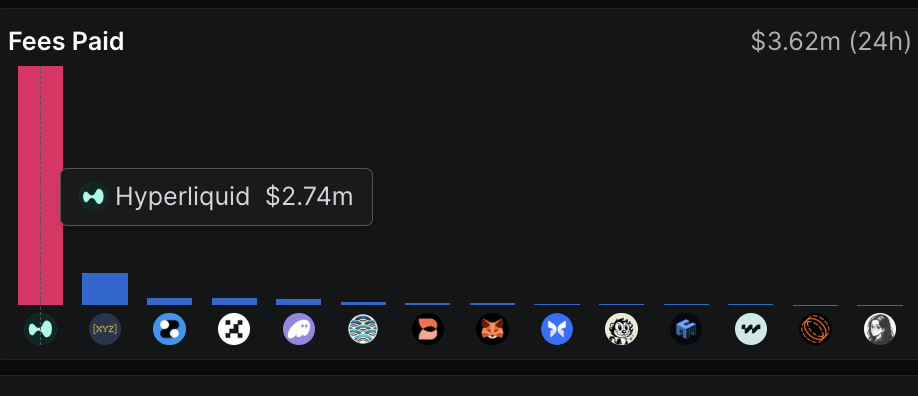
On the supply side, only about 26,790 HYPE are minted daily as staking rewards. Recent daily burn figures have exceeded 48,000 HYPE, resulting in a net removal of over 17,000 tokens per day. Burns are currently running 1.8 to 2.3 times faster than emissions.
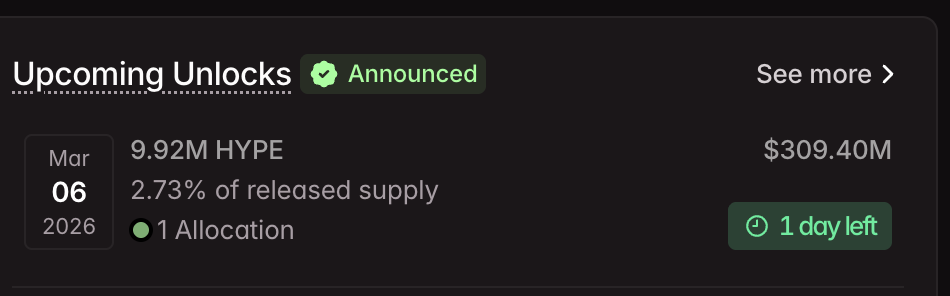
That makes HYPE structurally net deflationary at current volume levels, even after accounting for the scheduled March 6 unlock of roughly 9.92 million HYPE for core contributors.
The flywheel is straightforward. More traders using Hyperliquid to trade oil, gold, stocks, and commodities around the clock generate higher fees. Higher fees mean more HYPE bought from the market and burned. More burning means a shrinking supply. And shrinking supply, combined with rising demand, creates price support, which is exactly what smart money appears to be positioning for.
Smart Money Goes All In While Retail Bets Against
On-chain positioning data on HYPE itself reveals a sharp divide between smart money and retail.
According to Nansen AI, overall sentiment on HYPE among tracked smart money wallets reads “strongly bullish.”
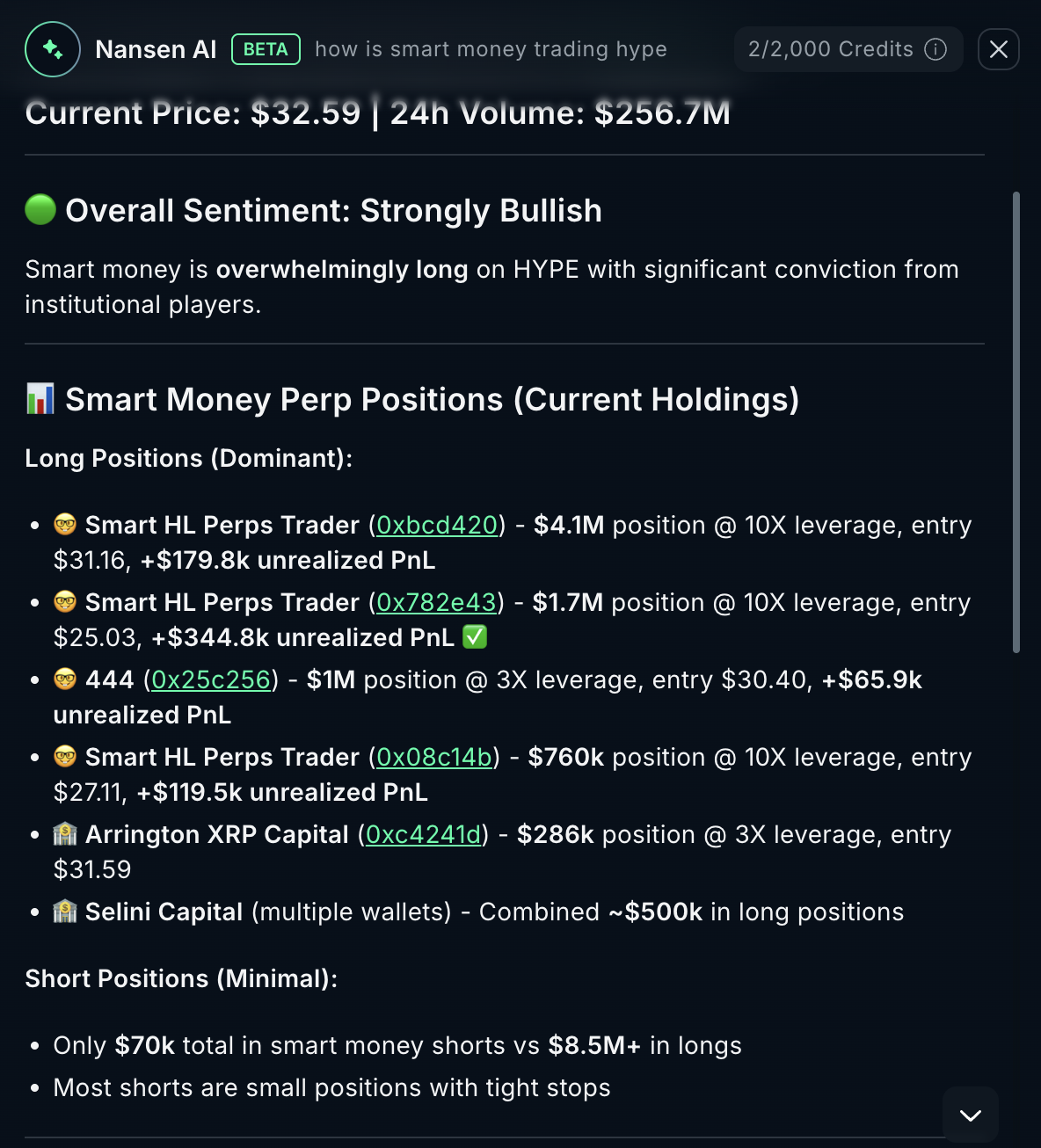
Named participants include Arrington XRP Capital with a $286,000 long entered near $31. Another one is Selini Capital with roughly $500,000 in combined longs across multiple wallets. Plus, there are several tracked smart Hyperliquid perps traders with entries ranging from $25 to $31 — all sitting on unrealized profits at press time.
Retail, however, is positioned in the opposite direction, especially in the broader timeframe. The Bybit HYPE/USDT 30-day liquidation map shows cumulative short liquidation leverage at approximately $33 million compared to roughly $23 million on the long side.
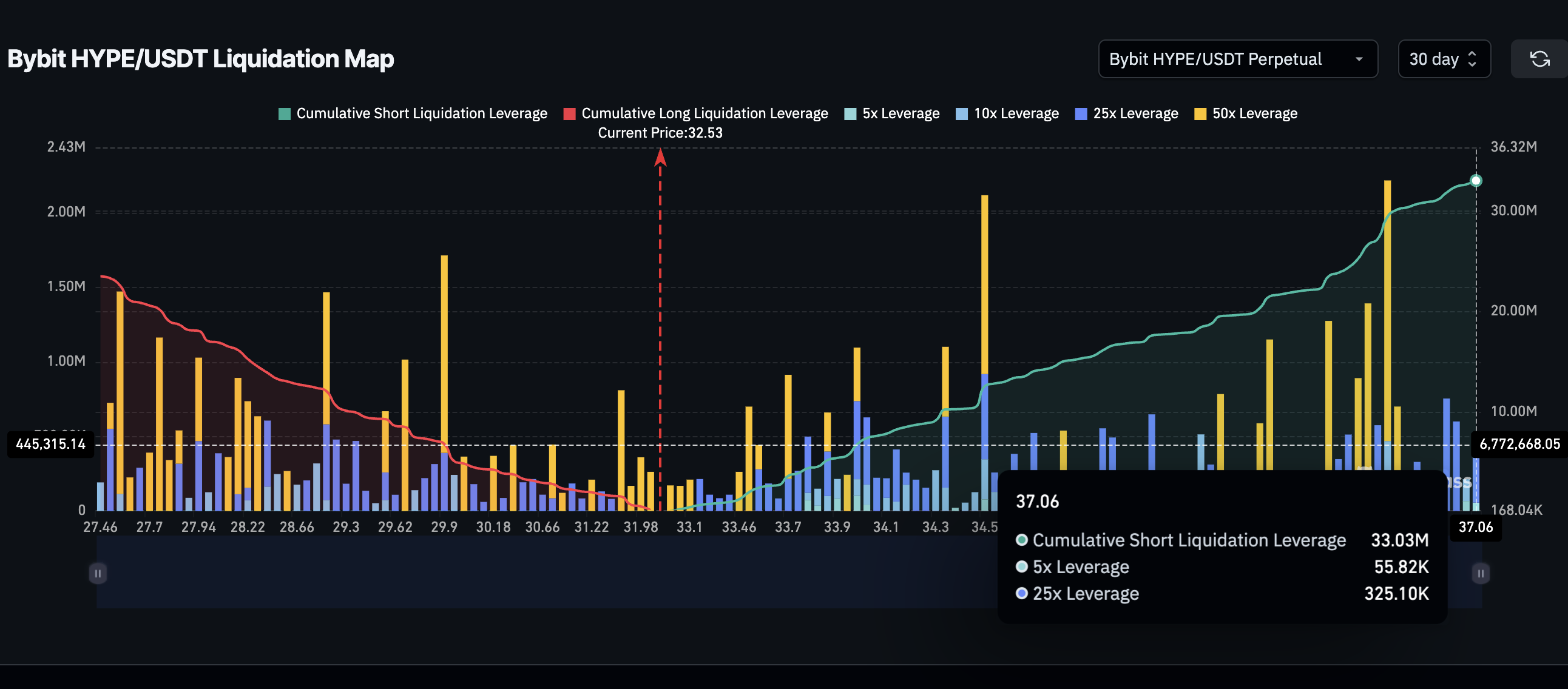
Short leverage clusters build significantly above the $34 range, creating potential fuel for a short squeeze if the Hyperliquid price pushes through that zone.
The Smart Money Index, which tracks the positioning of informed traders, on the technical chart, adds further confirmation for what the Nansen AI highlighted. It crossed above the signal line around Feb. 28, coinciding with the price acceleration. During the late January rally, this same indicator turned down right as sellers rejected HYPE at $43. This time, the indicator is pointing up again, though it still needs to clear the nearest horizontal resistance to confirm stronger momentum.
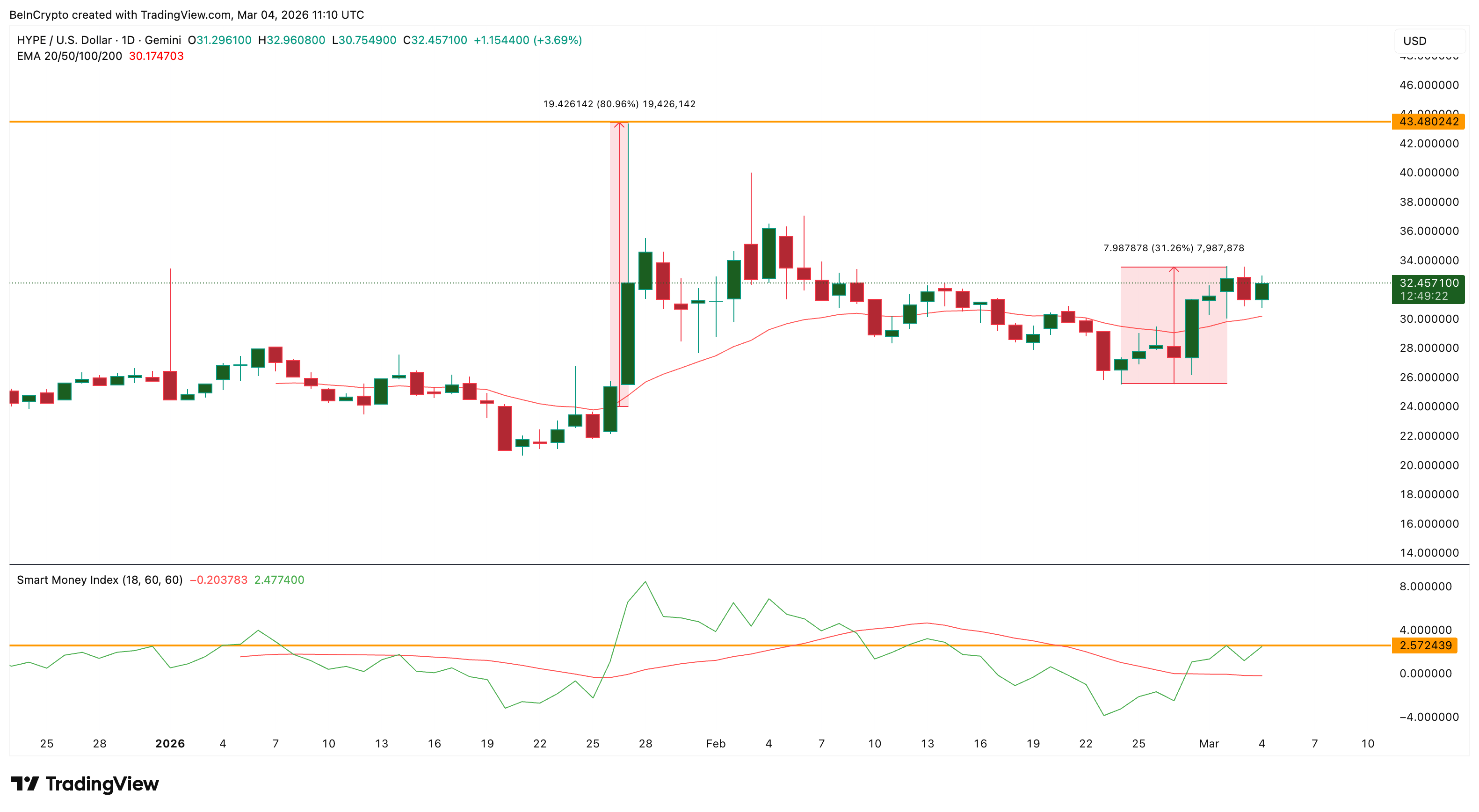
The divide is clear: smart money is accumulating HYPE while retail leans short. That setup, combined with the liquidation clusters above the price, has historically preceded sharp upward moves in crypto markets. And the technical levels above map out exactly where the next legs could go.
HYPE Price Targets $62 for a New All-Time High
The Hyperliquid price rally gained further technical significance when HYPE crossed and reclaimed the 20-day exponential moving average (EMA), a trend-following indicator. The last time this reclaim happened was in late January. HYPE subsequently rallied approximately 81% to $43 before sellers forced a correction.
Despite the current move measuring 31% from the swing low, HYPE is only about 15% above the 20-day EMA level itself. In the January instance, the token had moved much further above its EMA at the equivalent stage before accelerating into the full 81% rally. This suggests the current move may still be in its early stages if the pattern repeats.
Technical extension levels show that the immediate resistance sits near $34. It is also the zone where short liquidation leverage begins stacking heavily, making it the first real test. A break above $34 could trigger cascading short liquidations that accelerate the move.
The $39 represents one of the higher levels, followed by $43. Beyond $43, the technical extension reaches $48 and $62, which would represent a new all-time high, surpassing the September 2025 peak of over $59. From the current price near $32, that represents roughly 90% upside.
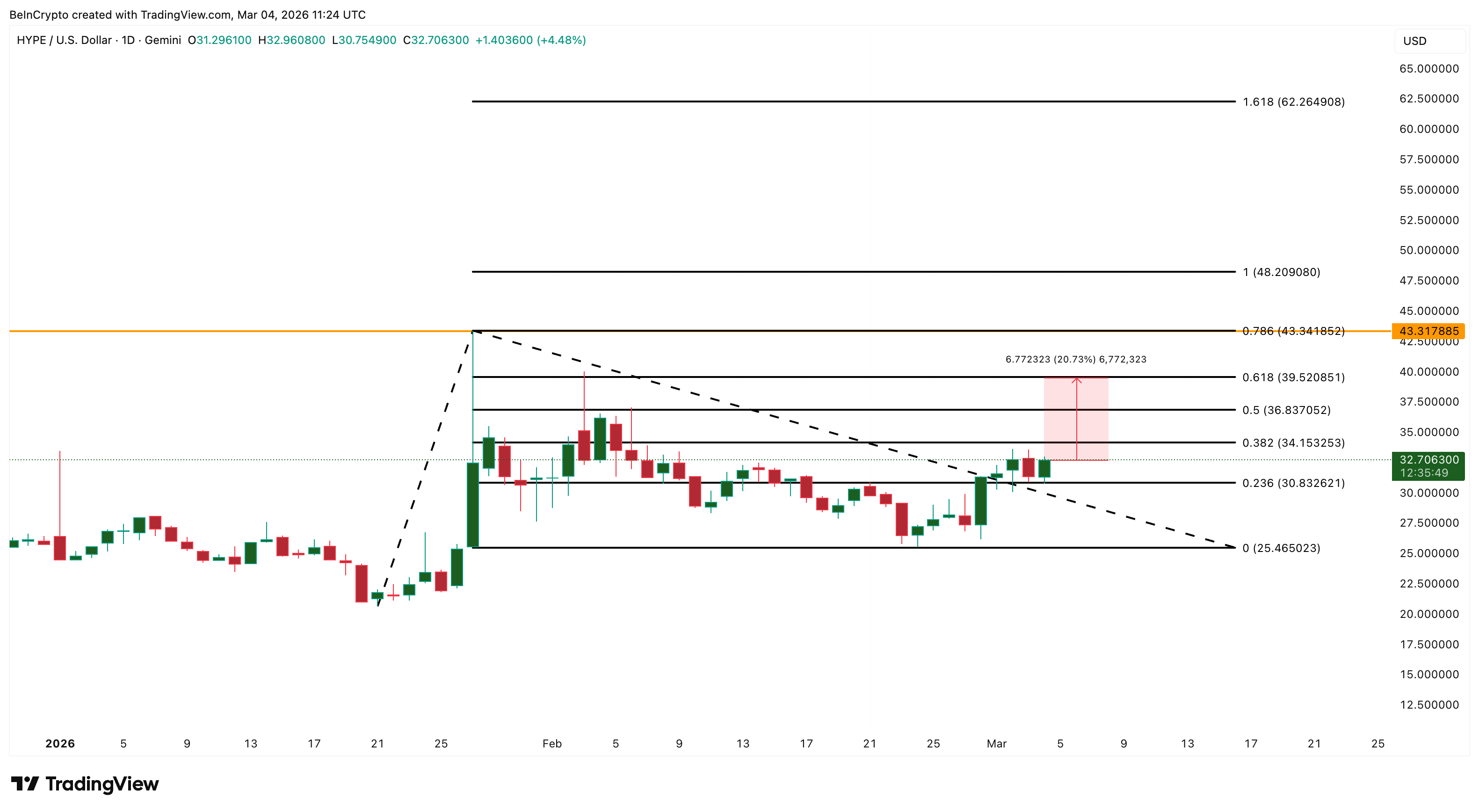
On the downside, losing $30 would weaken the bullish structure. A drop below $25 would invalidate the setup entirely, regardless of how strong the TradFi burn flywheel remains.