
David Morgan’s Warning: What Comes Next For Gold And Silver | Headline USA
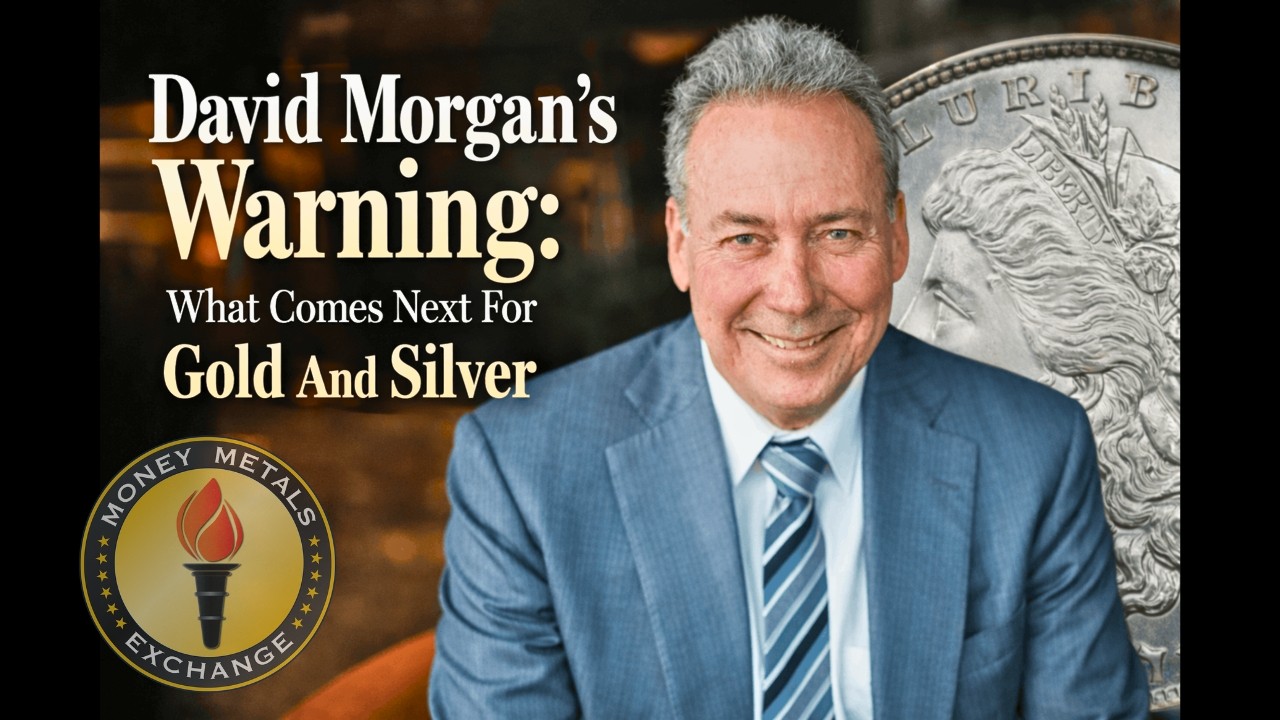
(Money Metals News Service) In a recent Money Metals Podcast episode (recorded on Thursday, January 29, 2026), host Mike Maharrey interviewed precious metals analyst David Morgan, publisher of The Morgan Report.
Morgan agreed that the move looks parabolic on a chart. He also cautioned against assuming the rally is just retail euphoria. He pointed out that many physical silver holders have been net sellers even as prices rise, which implies the strongest buying pressure may be coming from larger, more strategic sources.
(Interview Starts Around 6:54 Mark)
Parabolic prices, but not a simple bubble story
This episode carries a real warning, and it is not simply that gold and silver have gone up fast.
David Morgan’s caution is that markets can enter a phase where prices push much higher while volatility becomes more punishing. In that environment, investors can be “right” on the long-term direction and still get shaken out by sudden drops, widening spreads, or fast reversals driven by positioning and paper-market speed.
With gold trading over $5,000 and silver surging above $100 (on the day of recording), including an intraday print around $121, Mike Maharrey asked Morgan what comes next. Morgan agreed the move looks parabolic on a chart, but he argued this does not look like a classic retail blow-off. He noted that many physical silver holders have been net sellers even as prices rise, which implies the strongest buying pressure may be coming from larger, more strategic sources.
India, China, and the global reserve shift
Morgan pointed to India and China as major forces behind demand, describing it as intense and difficult to satisfy in real time. He framed the current bid in metals as a response to rising geopolitical risk and deteriorating trust in reserve assets.
He singled out the freezing of roughly 300 billion in Russian national reserves as a turning point. In his view, that episode showed that dollar-held reserves can be politically constrained, pushing more countries to treat gold as a neutral asset that sits outside direct U.S. control.
As one example, he cited China’s reported reduction in U.S. Treasury holdings from about 1 trillion down to roughly 600 billion over a relatively short period. He argued that some of that shift likely flowed into gold.
The spike, the dump, and algorithm-driven volatility
Maharrey asked about the sudden reversal. Silver ran to around $121, then pulled back sharply. Gold dropped more than $300, and silver slid toward roughly $111 or lower before stabilizing.
Morgan attributed much of that kind of intraday action to algorithmic trading and leveraged paper markets. He described how selling can snowball once momentum breaks, then intensify when large players manage short exposure or attempt to trigger cascading stops. His broader point was that fundamentals can be strong while price behavior still looks chaotic, especially late in a major move.
The 1971 break and why retirement money matters
Morgan tied the moment to the post–August 15, 1971 monetary era, arguing that decades of confidence in the dollar and Treasuries are now being tested more openly.
He and Maharrey then discussed how under-allocated most investors are to precious metals. Morgan said many portfolios hold less than 1% and sometimes 0%. He argued that if even a modest share of retirement capital begins treating gold and silver as true portfolio hedges, incremental demand could remain powerful even at elevated prices.
They talked through a simplified allocation model like 60/20/20. Morgan described what it might look like if a typical 401(k), such as 400,000, shifted 20% into gold alongside 60% in stocks and 20% in a money market. The numbers served as an illustration of scale more than a one-size-fits-all prescription.
A disciplined gold–silver ratio swap plan
With the gold–silver ratio around 46:1 during the interview, Morgan laid out a structured approach for investors who want to swap silver into gold as the ratio compresses. He suggested starting around 50:1, then making additional swaps at 40:1 and 30:1. He also offered a guideline of swapping 20% at the 30:1 level.
He described 20:1 as a deeper target if the move turns extreme. He referenced how the ratio hit about 33 in 2011 only briefly, and he argued that late-stage moves can happen fast. That is why he prefers predefined levels rather than improvising during a spike.
Silver shortage signals, and why North America looks out of sync
Maharrey pressed the core question about whether silver’s surge is fundamentally about a shortage.
Morgan said it certainly appears that way. He described a strong pull for commercial 1,000-ounce bars driven by a mix of ETF-related buying and industrial demand, with a particular focus on Asia.
At the same time, both men noted an odd contrast in North America. They discussed wide buyback spreads of about 10 to 15 in some channels and reports of reluctance around buying 90% silver. They viewed that as inconsistent with a market experiencing intense global demand.
Maharrey added a dealer-level detail to reinforce the point. Money Metals has shipped 1,000-ounce bars to India, and he is seeing buying pick up after a stretch where selling dominated.
The personal note that closes the loop
Morgan closed with a reminder that the point is not to “win” every swing. It is to understand the kind of market you are in and to avoid decisions that only make sense in calm conditions. His warning is that the next phase can be defined by speed and disorder, with sharp selloffs that appear without notice, followed by equally abrupt recoveries.
Even the lighter ending reinforced the theme. Morgan joked he is not related to George T. Morgan of Morgan Dollar fame, and he described meaningful pieces he keeps for the story rather than the premium, including a “Silver Circle” round tied to an animated film project he supported and a coin featuring the Declaration of Independence micro-engraved on the reverse.
The message was simple. If gold and silver are entering a higher-volatility era, investors who plan ahead and stay disciplined will handle it better than those who react to every spike and dump. Stay connected with David Morgan on X (formerly Twitter) @silverguru22.